Evidence-Based Research: The Foundation of Informed Decision-Making in the Modern World Introduction
Evidence-Based Research: The Foundation of Informed Decision-Making in the Modern World
Introduction
In an era defined by rapid change, uncertainty, and information overload, decision-makers across governments, businesses, academic institutions, and development organizations face increasing pressure to make the right choices. Poor decisions can result in wasted resources, failed projects, ineffective policies, and long-term social or economic harm. This is where evidence-based research becomes essential.
Evidence-based research provides a systematic, transparent, and reliable approach to understanding complex problems and identifying effective solutions. Rather than relying on assumptions, opinions, or intuition, evidence-based research grounds decisions in verified data, rigorous analysis, and proven methodologies.
At Talosamo, we believe that high-quality research is not just an academic exercise—it is a strategic tool that empowers organizations to act with confidence, accountability, and impact. This article explores the meaning, importance, methods, applications, and future of evidence-based research in today’s world.
What Is Evidence-Based Research?
Evidence-based research is an approach that emphasizes the use of credible data, systematic analysis, and verifiable findings to inform decisions, policies, and actions. It integrates three key elements:
Best available evidence from data and research
Professional expertise and methodological rigor
Contextual understanding of the problem being addressed
Unlike opinion-based decision-making, evidence-based research follows structured processes that reduce bias, improve accuracy, and enhance reliability.
The Evolution of Evidence-Based Research
Early Foundations
The roots of evidence-based research can be traced back to scientific inquiry and academic scholarship, where observation, experimentation, and documentation formed the basis of knowledge creation. Over time, these principles expanded beyond science into fields such as economics, education, healthcare, and public policy.
Modern Research Standards
Today, evidence-based research is guided by international standards that emphasize:
Transparency in methodology
Ethical data collection
Reproducibility of results
Peer review and validation
Digital technologies and advanced analytics have further strengthened research practices by enabling access to larger datasets, faster analysis, and improved accuracy.

Why Evidence-Based Research Matters
- Improves Decision Quality
Decisions grounded in evidence are more likely to achieve desired outcomes. Research reduces uncertainty by providing clear insights into risks, opportunities, and expected results.
- Enhances Accountability
Organizations that rely on evidence can justify their decisions to stakeholders, funders, and the public. This is especially critical for governments, NGOs, and development agencies.
- Reduces Risk and Waste
Evidence-based planning helps avoid costly mistakes by identifying ineffective strategies before resources are committed.
- Builds Trust and Credibility
Research-backed decisions enhance institutional credibility and foster trust among partners, clients, and communities.
Types of Evidence-Based Research
Quantitative Research
1. Quantitative research focuses on numerical data and statistical analysis. It answers questions such as:
How many?
How often?
To what extent?
Common methods include:
Surveys
Experiments
Statistical modeling
Large-scale datasets
Qualitative Research
2.Qualitative research explores experiences, perceptions, and meanings. It provides depth and context to complex social or organizational issues.
Common methods include:
Interviews
Focus group discussions
Case studies
Observational research
Mixed-Methods Research
Mixed-methods research combines quantitative and qualitative approaches to provide a more comprehensive understanding of a research problem. This approach is increasingly popular in policy, development, and academic research.
The Evidence-Based Research Process
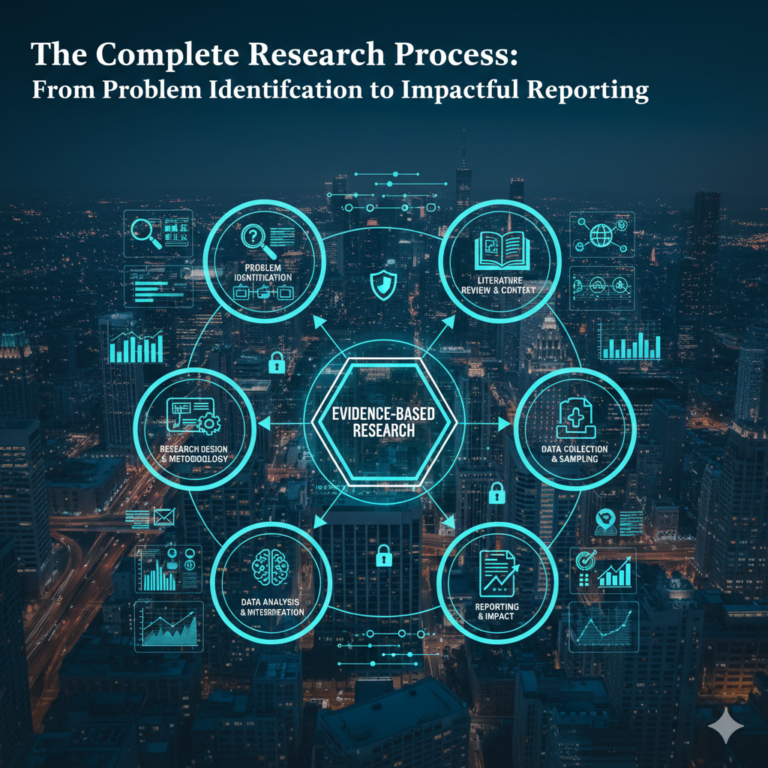
- Problem Identification
Effective research begins with a clearly defined problem or question. A well-framed research question guides the entire process and ensures relevance.
- Literature Review
A literature review examines existing research to:
Understand current knowledge
Identify gaps
Avoid duplication
Strengthen theoretical foundations
- Research Design
The research design outlines:
Methodology
Sampling strategy
Data collection tools
Ethical considerations
- Data Collection
Data may be collected through surveys, interviews, observations, secondary sources, or digital platforms. Accuracy and ethical integrity are essential at this stage.
- Data Analysis
Analysis transforms raw data into meaningful insights using statistical techniques, thematic analysis, or comparative frameworks.
- Interpretation and Reporting
Findings are interpreted within context and presented in clear, accessible formats such as reports, policy briefs, or dashboards.
Ethics in Evidence-Based Research
Ethical research practices are fundamental to credibility and trust. Ethical considerations include:
Informed consent
Confidentiality and data protection
Avoidance of bias and manipulation
Transparency in reporting
At Talosamo, ethical standards guide every stage of the research process.
Evidence-Based Research in Policy Development
Governments and public institutions increasingly rely on evidence to design effective policies. Research helps policymakers:
Identify societal needs
Evaluate policy alternatives
Measure policy impact
Improve service delivery
Evidence-based policymaking leads to more equitable, efficient, and sustainable outcomes.
Evidence-Based Research in Business and Markets
In the private sector, evidence-based research supports:
Market analysis and feasibility studies
Consumer behavior insights
Product development
Strategic planning
Businesses that invest in research gain competitive advantage and reduce uncertainty in decision-making.
Evidence-Based Research in Development and NGOs
Development organizations and NGOs use evidence to:
Design impactful interventions
Monitor and evaluate programs
Demonstrate accountability to donors
Improve long-term sustainability
Research ensures that development efforts are effective, inclusive, and responsive to community needs.
Monitoring and Evaluation (M&E) as Evidence
Monitoring and Evaluation is a specialized form of evidence-based research focused on performance and impact. M&E helps organizations:
Track progress against objectives
Identify challenges early
Measure outcomes and impact
Inform future programming
Strong M&E systems strengthen organizational learning and accountability.
Common Challenges in Evidence-Based Research
Despite its benefits, evidence-based research faces challenges such as:
Limited data availability
Resource constraints
Time pressures
Political or organizational resistance
Misinterpretation of findings
Addressing these challenges requires skilled researchers, strong methodologies, and institutional commitment.
The Role of Technology in Modern Research
Digital tools are transforming research practices through:
Online surveys and data collection
Big data analytics
Artificial intelligence and machine learning
Data visualization and dashboards
Technology enhances efficiency, accuracy, and accessibility of research outputs.
The Future of Evidence-Based Research
The future of research will be shaped by:
Greater integration of digital tools
Increased demand for transparency
Cross-disciplinary collaboration
Open data and knowledge sharing
Organizations that invest in research capacity will be better positioned to adapt and thrive in a rapidly changing world.
Why Partner with a Professional Research Company
Professional research companies like Talosamo bring:
Technical expertise
Methodological rigor
Ethical standards
Clear and actionable reporting
Partnering with experts ensures high-quality research outcomes that support informed decision-making.
Conclusion
Evidence-based research is no longer optional—it is essential. In a world of complexity and uncertainty, reliable evidence provides clarity, direction, and confidence. Whether in policy, business, academia, or development, research-driven decisions lead to better outcomes and lasting impact.
At Talosamo, we are committed to delivering research that meets the highest standards of quality, ethics, and relevance. Through evidence-based approaches, we help organizations transform data into insight and insight into action.