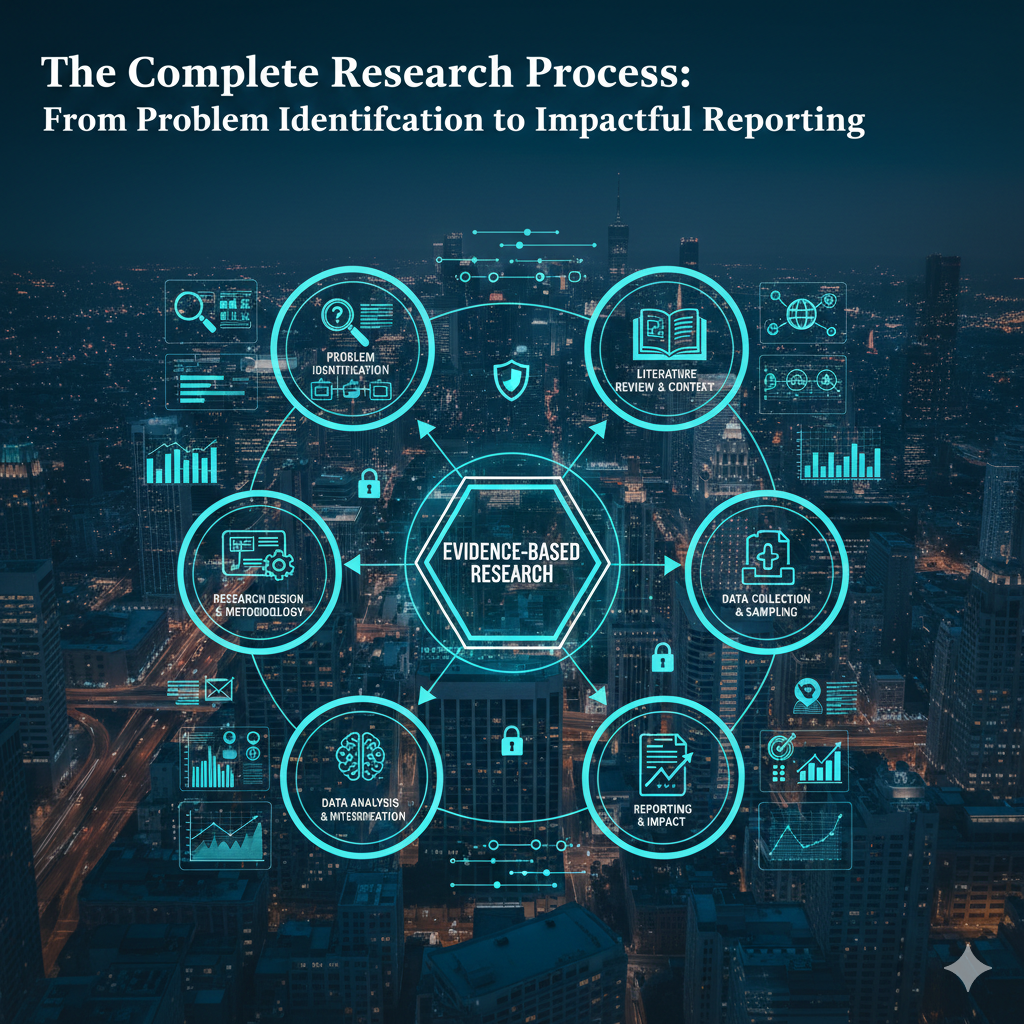
The Complete Research Process: From Problem Identification to Impactful Reporting Introduction
High-quality research does not happen by chance. Behind every credible report, policy brief, or academic paper lies a structured and disciplined process that ensures accuracy, relevance, and impact. Many organizations collect data, but only a few transform it into reliable evidence that can guide meaningful decisions.
Understanding the full research process is essential for governments, businesses, academic institutions, and development organizations that rely on data to plan, evaluate, and improve their work. A weak research process can lead to misleading conclusions, wasted resources, and poor outcomes.
At Talosamo, research is treated as a systematic journey—from identifying the right problem to producing insights that drive real-world impact. This article provides a comprehensive guide to the research process, explaining each stage in detail and highlighting best practices used by professional research organizations.
Understanding the Purpose of Research
Before exploring the steps, it is important to understand why research is conducted. Research serves several key purposes:
To understand complex problems
Effective research is always purpose-driven. Without a clear objective, even well-collected data can become meaningless.
Step 1: Problem Identification and Research Questions
Defining the Research Problem
The foundation of any research project is a clearly defined problem. A research problem describes the issue or gap that needs to be understood or addressed. Poorly defined problems often lead to unfocused studies and weak conclusions.
Once the problem is identified, it is translated into research questions. These questions guide the entire research process.
Step 2: Literature Review and Context Analysis
Purpose of the Literature Review
A literature review examines existing research, reports, and data related to the research topic. It helps researchers understand what is already known and where gaps exist.
At Talosamo, literature reviews are conducted systematically to ensure accuracy and relevance.
Step 3: Research Design and Methodology
Choosing the Right Research Design
The research design outlines how the study will be conducted. It connects research questions with data collection and analysis methods.
Common research designs include:
Descriptive research
Exploratory research
Explanatory research
Experimental and quasi-experimental designs
Selecting Research Methods
The choice of methods depends on the research objectives:
Quantitative methods for measuring trends, patterns, and relationships
Qualitative methods for exploring experiences, perceptions, and meanings
Mixed-methods for comprehensive analysis
A strong methodology ensures validity, reliability, and credibility of findings.
Step 4: Sampling and Study Population
Understanding the Study Population
The study population refers to the group or units being studied, such as individuals, organizations, communities, or institutions.
Sampling Techniques
Because it is often impractical to study entire populations, sampling is used. Common sampling methods include:
Random sampling
Stratified sampling
Purposive sampling
Cluster sampling
The sampling strategy directly affects the generalizability and accuracy of research findings.
Step 5: Data Collection Methods
Primary Data Collection
Primary data is collected directly from original sources. Common methods include:
Surveys and questionnaires
Interviews
Focus group discussions
Observations
Secondary Data Collection
Secondary data comes from existing sources such as:
Government databases
Academic studies
Institutional reports
International datasets
Professional researchers assess data quality, relevance, and reliability before use.
Step 6: Data Quality and Validation
Data quality is critical. Poor-quality data leads to unreliable conclusions.
Key quality checks include:
Accuracy and completeness
Consistency
Timeliness
Relevance
Validation techniques such as data cleaning, triangulation, and cross-checking are essential parts of professional research.
Step 7: Data Analysis and Interpretation
Quantitative Data Analysis
Quantitative analysis involves statistical techniques to identify patterns and relationships. This may include:
Descriptive statistics
Regression analysis
Trend analysis
Comparative analysis
Qualitative Data Analysis
Qualitative analysis focuses on meaning and context through:
Thematic analysis
Content analysis
Narrative analysis
Interpretation of Findings
Analysis alone is not enough. Researchers must interpret results within the study context, considering limitations and external factors.
Step 8: Ethics and Research Integrity
Ethics are central to professional research practice. Ethical research protects participants and ensures credibility.
Key ethical principles include:
Informed consent
Confidentiality
Data protection
Transparency
Avoidance of bias
At Talosamo, ethical compliance is integrated into every research project.
Step 9: Reporting and Knowledge Translation
Writing Research Reports
Research findings must be communicated clearly and accurately. A strong report typically includes:
Executive summary
Methodology
Findings
Discussion
Conclusions and recommendations
Making Research Accessible
Different audiences require different formats:
Policymakers prefer briefs
Businesses prefer insights and dashboards
Academics prefer detailed reports
Effective reporting ensures research findings are understood and used.
Step 10: From Research to Impact
Using Research for Decision-Making
The ultimate goal of research is impact. Evidence should inform:
Policy formulation
Strategic planning
Program improvement
Investment decisions
Monitoring Impact
Follow-up and evaluation help assess how research findings are applied and what outcomes they produce.
Common Mistakes in the Research Process
Despite best intentions, many research projects fail due to:
Poorly defined questions
Weak methodologies
Biased data collection
Inadequate analysis
Poor communication of results
Professional research practices help avoid these pitfalls.
The Role of Professional Research Organizations
Research companies like Talosamo provide:
Methodological expertise
Objective analysis
Ethical oversight
High-quality reporting
Partnering with professionals ensures research meets international standards and delivers real value.
Research in a Digital and Data-Rich World
Modern research is increasingly shaped by technology:
Digital surveys
Big data
Real-time analytics
Data visualization tools
These innovations improve efficiency but also require strong technical and ethical capacity.
Building a Research Culture
Organizations that value research:
Encourage evidence-based thinking
Invest in data systems
Support learning and innovation
A strong research culture leads to better long-term outcomes.
Conclusion
The research process is a structured and disciplined journey that transforms questions into knowledge and knowledge into action. Each step—from problem identification to reporting—plays a critical role in ensuring credibility, relevance, and impact.
At Talosamo, research is more than data collection. It is a commitment to quality, ethics, and evidence-based solutions that support informed decision-making across sectors.
Do you need professional research support for your organization or project?
Contact Talosamo to turn data into insight and insight into impact.